|
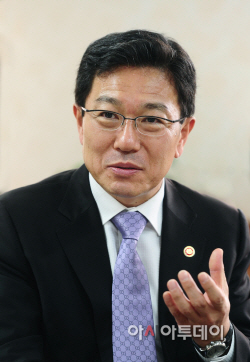
Minister Yoon Sang-jik from the Ministry of Trade, Industry and Energy had an interview with AsiaToday on the 27th and revealed that he will actively take part in shaping the development of renewable energy that fits into Korea.
Since the government‘s policy on renewable energy has been rather focusing on electricity sector and putting efforts to expand facilities, he expressed his willingness for more practical approach in the future. Yoon picked ’heat (solar heat, geothermal heat, biomass) delivery (eco-friendly vehicle) market creation‘ as a source of renewable energy.
When asked about the reason for his strong willingness for Korean style renewable energy development, Yoon answered, “We accomplished quantitative growth of renewable energy business through active growth policies and investment.”
In fact, the number of renewable energy companies expanded to 225 in 2011 from 100 in 2007, and the amount invested increased to 4.58 trillion won from 523 billion won.
However, Yoon admitted that Korea’s renewable energy industry is still facing many challenges to solve apart from quantitative growth.
Minister Yoon said, “For renewable energy expansion, the range of supply business will be expanded from individual units such as buildings and houses, to local community-oriented units. We will also promote R&D to support new technologies‘ market penetration.”
He also emphasized the importance of building Northeast Asia’s oil hub as another mainstay of the national energy policy development. He said, “The Northeast Asia‘s oil hub is an ideal opportunity for Korea to become one of the energy powers.”
In order to develop Korea as the center of oil hub in Northeast Asia, the government put 2 trillion won of private investment to build oil tank terminals to a scale of 36.6 million barrels in Ulsan and Yeosu by 2020, aiming to produce economic effects of 60 trillion won and attract petroleum traders.
To this end, the Ministry also embarked on regulatory reform. The primary goal of the regulatory reform is lowering entry barriers.
Yoon said, “As entry barriers are lowered due to deregulation, we expect to attract global trading companies to create jobs and new added values.”